
A morning in Hue can begin gently. The city is not fully awake yet, the light is soft on the river, boats move slowly and the trees along the road make time feel less hurried. For first-time visitors, this moment helps the journey move beyond a simple list of sites. Before entering the Imperial City or the royal tombs, sitting with a coffee, watching local life and hearing a few stories about the river and its two banks can make the heritage feel closer and more human.
A good guide does not need to say too much at the beginning. A few details about the former capital, about the way Hue people preserve manners in daily life, and about why the colours and silence here feel different from Hoi An or Hanoi are enough to prepare the whole day. Once travellers sense the living space around them, the Imperial City is no longer a large complex of names and gates; it becomes a place where people lived, worked, waited for news, received guests and maintained power through a very particular order.
When heritage is not only behind the citadel walls
Hue is not only made of mapped heritage sites. A quiet alley, a local bowl of bun bo, a garden house with fruit trees and an old family altar, or a story about home cooking can reveal another layer of the city. If travellers move too quickly from one famous stop to another, they may remember Hue by monument names. If they also listen to the life around those monuments, they remember Hue through atmosphere, voices and the way local people live with the past.
A meal that tells history in a simple way
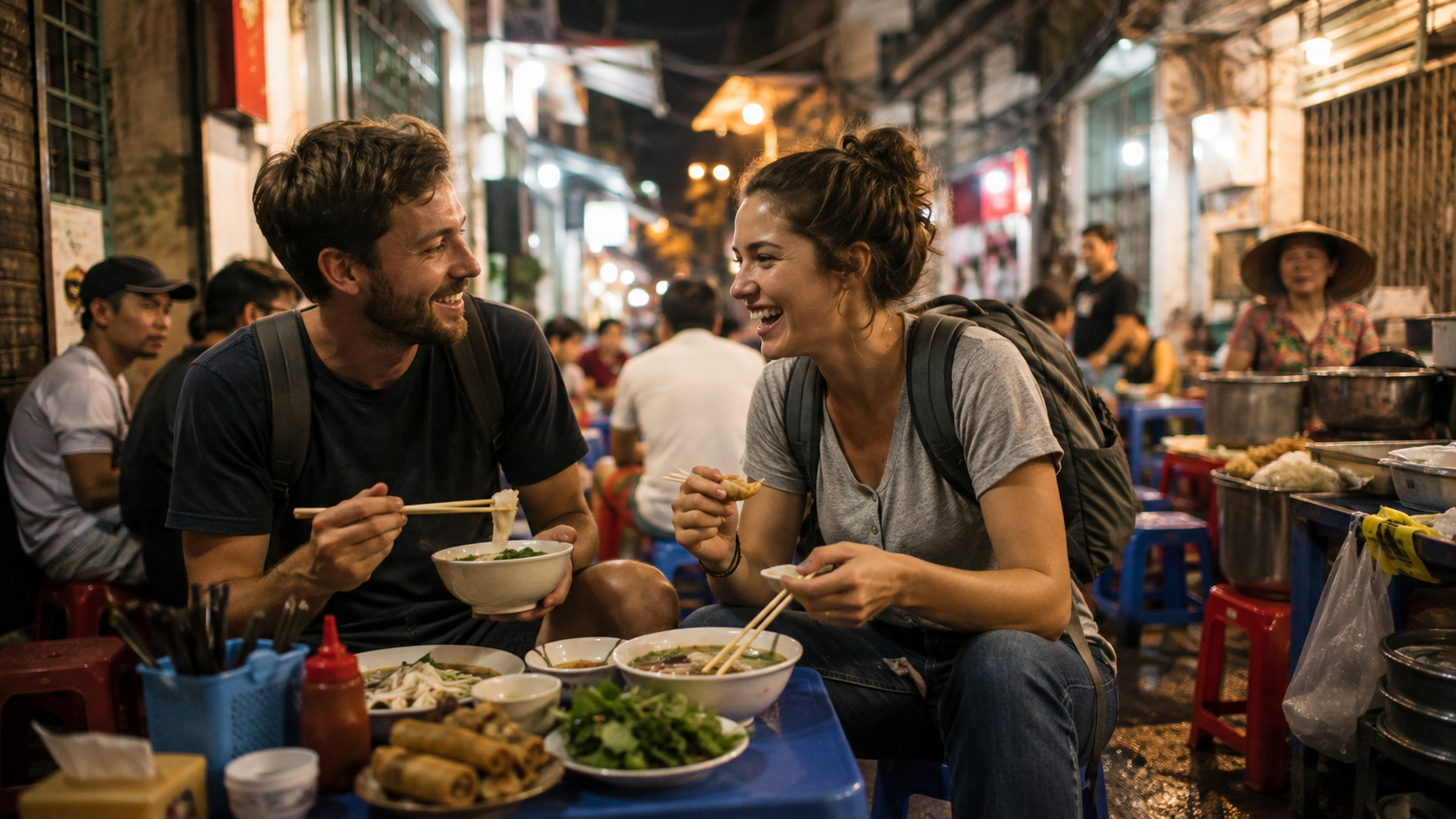
Food is one of the most natural ways to understand Hue. Many dishes here are small, delicate, layered in flavour and carefully presented. From bun bo and com hen to banh beo, banh nam and dishes influenced by court cuisine, each choice reflects something of the city’s character: discreet, precise, not trying too hard to impress at first, but more memorable when tasted slowly. A well-chosen meal can explain Hue better than many formal introductions.
For international travellers, the guide or travel planner should explain the food through accessible stories, not turn the meal into a lecture. Why certain herbs are used, why Hue spice can feel deeper, why small portions and many dishes suit the local way of eating: these details help guests enter local life without feeling distant from it. If the group needs vegetarian food, lighter flavours or limited spice, the itinerary should be adjusted in advance so the local experience remains comfortable.
This is also where a travel consultation becomes useful. If travellers want a more emotional day in Hue, they should share their food preferences, cultural interests, walking comfort and wish for local encounters before the trip. Tradition Việt can use these details to design a day that follows the right route, but also matches the way each group wants to experience Vietnam.
An immersive Hue itinerary example
From the Imperial City to a quiet pause
An immersive journey can begin at the Imperial City in the morning, when the weather is still pleasant and the light makes the walls, gates and brick courtyards clearer. Instead of trying to cover every corner, the guide can choose a focused route: one part to explain the structure of power, one part to evoke daily life inside the citadel, and one part to show why Hue remains so important in Vietnamese culture. This selection gives the visit depth without overwhelming travellers with too many names.
After the Imperial City, a short pause is essential. It may be a quiet cafe, a light lunch or time to rest at the hotel if the group includes older travellers. A pause does not weaken the itinerary; it allows the afternoon to feel intentional rather than obligatory. In Hue, alertness and comfort often matter more than the number of stops completed.
If the group enjoys photography, this pause also helps avoid harsh sunlight and creates better chances for natural images. If the group enjoys history, the guide can use the break to connect what has just been seen with Hue’s present-day life. A good itinerary does not leave every detail separate; it lets the day’s different layers speak to one another.
Afternoon at the royal tombs and the people behind the architecture
The afternoon can be dedicated to one or two royal tombs, depending on the group’s energy. Hue’s tombs are not only beautiful architectural sites; they also reflect ideas about life, power, ageing, anxiety and aesthetics across different reigns. When the guide can reveal the person behind the monument, travellers no longer feel that the tombs are all the same. One may feel meditative, another theatrical, another may open a story about the meeting point between tradition and new influence.
What should be avoided is fitting too many tombs into one afternoon. Distance, weather and the amount of information can dilute the experience. A deeper Hue journey often chooses fewer sites and gives them more attention. Travellers remember one clear story, one beautiful angle or one detail explained at the right time more than a sequence of gates they can no longer distinguish from one another.
Ending with a glimpse of local life
At the end of the day, the experience should return travellers to present-day Hue: a local dinner, a gentle conversation, a small street or a moment by the river when the city begins to light up. This helps the journey close softly. After stories of dynasties, palaces and tombs, travellers need to see that Hue is still alive, still cooking, trading, praying, preserving family ways and welcoming guests in its own quiet manner.
Frequently asked questions
How long should an immersive Hue experience take?
At least one full day is recommended so there is time for heritage, food, pauses and a glimpse of local life. Two days make the experience much more comfortable.
Should I visit as many sites as possible in Hue?
Not if your goal is depth. Hue is better with fewer, better-selected stops, so you have time to understand the stories and feel the atmosphere.
Should food be part of a Hue itinerary?
Yes. Food is one of the easiest ways to understand Hue’s character, from delicate preparation to the city’s distinctive local flavours.
Does a private tour improve the Hue experience?
Yes, especially for travellers who want historical context, a slower pace, private transport, guiding and an itinerary adapted to the group’s energy.
What should I send to Tradition Việt before planning Hue?
Send your travel dates, number of guests, ages, interests, food preferences and walking comfort so the itinerary can be adjusted realistically.
Send us your expected travel dates, number of travelers and main wishes to receive itinerary advice and a suitable quote from Tradition Việt.
📞 Hotline: (+84)967 04 88 91 / (+84)376 304 008
📧 Email: info@traditionviet.com
Address: CT2A, Hanoi Homeland, Thuong Thanh Ward, Long Bien District, Hanoi.